Why Choose Naga Precision Tool
GENERAL SPECIFICATION OF NAGA TOOL HOLDERS
1) TOOL HOLDERS MATERIAL
Naga Tool holders are made out of good quality alloy case hardening steel to provide good surface hardness and guaranteed tensile core strength of < 800N / m * m and heat treated to a good hardness of 58-60 HRC with a minimum case depth of 0.6 mm, for a longer durability and maintain its accuracy for many years.
Also where the tool holder wall thickness is very small like ER16, ER16M, ER20M collet chucks, special steel and heat treatment processes are used to ensure optimum balance between core strength and surface hardness.
Also care has been taken to design and manufacturing every tool holder with stringent quality checks to produce products of very high quality.
2) TAPER ACCURACY
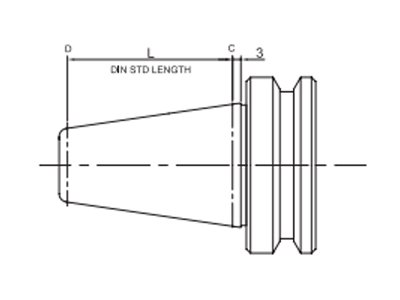
All 7/24 tapers like ISO 30,40 & 50 are ground and sizes are controlled and angular tolerance is maintaimed better than AT3 class. The AT3 specifications as per ISO 1947 and IS 7615 are as below.
| Taper | Tolerance | L | Roundness | Straightness | Taper Surface Roughness (Rz) |
|---|---|---|---|---|---|
| 30 | 0.002 | 39 | 0.001 | 0.001 | Rz < 0.002 |
| 40 | 0.003 | 59 | 0.002 | 0.001 | Rz < 0.002 |
| 50 | 0.004 | 92 | 0.002 | 0.001 | Rz < 0.002 |
Tolerance ATD
- Indicates the tolerance of diameter is difference between the real and theoretical value of the taper diameter at D.
- This Value of tolerance must always be less (negative), never more (possitive) in order to GUARANTEE a good tool holder seating at the bigger taper diameter.
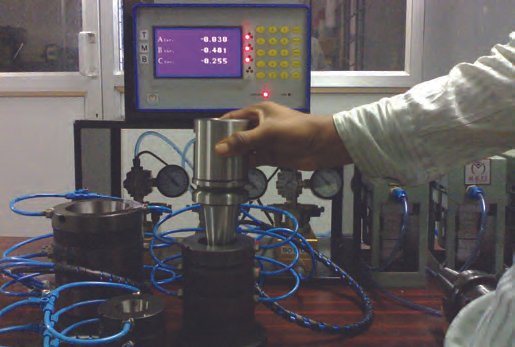
Naga is controlling AT3 dimensions by using latest technology Air electronic gauging systems, which is having three point measurement (T, M, B) for making sure that there is no concave (or) convex on the taper.
Fundamentals of Balancing
Causes of Unbalance
- Unsymmetrical design of the rotor (e.g. gripping groove on tool holders as specified in DIN 69871 or clamping screw on Weldon (side lock) tool holders, Eccentric ring in ER nuts)
- Unsymmetrical distribution of mass due to concentricity errors caused by manufacturing tolerance, e.g. concentricity of the tool outer diameter with respect to the taper.
What is unbalance ?
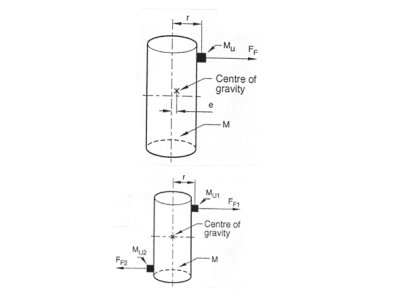
Static unbalance
- The centre of gravity of a rotor lies outside the axis of rotation.
- This can also be measured in stationary rotors, e.g. by means of unbalance scales for grinding wheels.
- Upon rotation this causes centrifugal forces perpendicular to the axis of rotation.
- It can be eliminated by balancing in one plane. Any balancing plane can be chosen.
- Normally there may still be couple unbalance after static balancing.
Couple unbalance
- The centre of gravity lies along the axis of rotation
- This can only be measured in rotating rotors.
- It causes a moment of tilt during rotation.
- The centrifugal forces of both unbalance masses counterbalance each other (no lateral forces).
- It can only be eliminated by balancing in 2 planes.
Dynamic Unbalance
- Combination of static and couple unbalance
- This is the normal case for tool holders.
What is balancing?
Balancing is used to make compensation for the unsymmetrical distribution of mass in a rotor. This is possible by,
- applying mass, e.g. a clamped weight to balance car tyres.
- removing mass, e.g. by drilling a hole
- adjusting mass, e.g. by adding balancing rings, screws.
Balancing in one plane (static)
Compensation for the static portion of an unbalance
- The centre of gravity of a rotor is brought back to the axis of rotation (ecentricity e = 0 , for the toolholder GPL up to 150 mm static balancing can be done.
Balancing in two planes (dynamic)
- Complete compensation for unbalance (static and couple unbalance), which is required for the toolholder GPL is more than 150 mm,
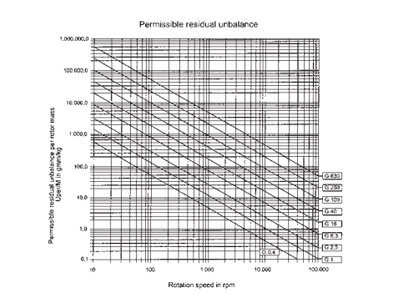
Balancing quality G
- DIN ISO 19401 (previously VDI guideline 2060) defines the principles for measuring unbalance and for balancing. The accuracy of balancing is expressed as balancing quality grade G (previously: Q)
- The permissible residual unbalance is calculated from the balancing quality grade, the rotation speed and the weight for the rotor.
Example
- U per Permissible residual unbalance of the holder in gmm
- G-balancing quality grade
- M – Weight of the holder in kg
- n – Rotation speed of the holder in rpm
- 9549-a constant that is produced after conversion of the measuring units.
- Operation speed: 15000 rpm
- Quality grade: G 2.5
- Weight of the holder – 1 kg
- U pec :1.59 gmm